Screen Time and Sleep: What the Evidence Actually Says

The short answer
Screen time is associated with later bedtimes, shorter sleep, and poorer self-reported sleep quality, but the evidence does not show that every screen session causes a bad night. Timing, interactive use in bed, content, and the sleep opportunity that the screen replaces all matter.
That distinction is worth keeping. “Screens ruin sleep” is tidy advice, but screen time can mean a work laptop at 8 p.m., a quiet e-book at 10 p.m., or 50 minutes of messages and short videos after getting into bed. Research often puts those activities under one label, then asks one sleep question weeks or months later.
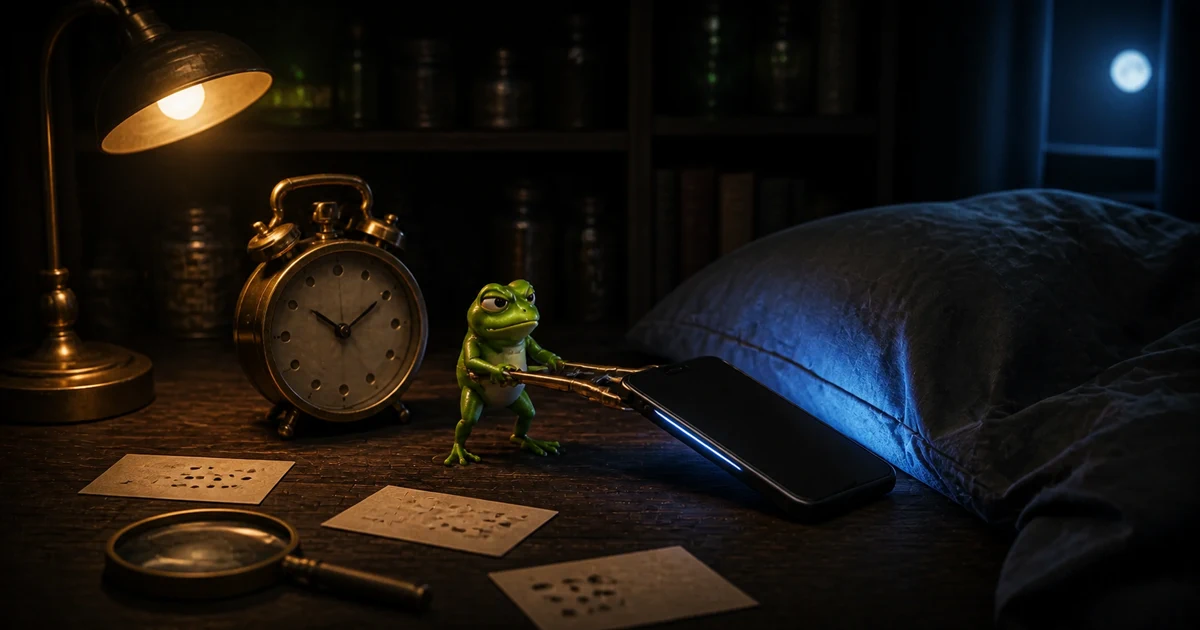
The sensible response is to focus on the part you can observe. If the phone keeps moving your attempt to sleep later, get it out of bed first. If you use a screen before bed without delaying sleep, do not turn one population association into a diagnosis.
What the strongest studies found
The studies agree more on the direction than the size. The estimate and its certainty change with the study design.
| Source | What researchers measured | Main result | What it cannot prove |
|---|---|---|---|
| Zhong et al., 2025 | A one-time survey of 122,058 adults about handheld screen use in the hour before bed and self-reported sleep | Daily use, compared with no use, was associated with 7.64 fewer minutes of sleep on workdays, 5.04 fewer minutes on nonworkdays, workday bedtimes 18.82 minutes later, and a 33% higher prevalence of poor sleep quality | The cross-sectional survey cannot establish causation or direction. It recorded days of use, not screen duration or content. |
| He et al., 2025 | A meta-analysis of 21 cohort studies with 548,338 participants across age groups | Eleven studies associated each additional daily screen hour with roughly 3 to 5 fewer minutes of sleep. Nine studies produced a pooled odds ratio of 1.25 for short sleep. | The studies were observational and usually relied on self-report. Definitions varied, and the binary results had very high heterogeneity. |
| Brosnan et al., 2024 | Four nights of video-observed screen activity and accelerometer-measured sleep in 79 youths aged 11 to 14 | Screen use in the two hours before bed was not associated with most sleep measures. Each extra 10 minutes of screen use once in bed was associated with 3 fewer minutes of sleep. | A small youth sample does not provide an adult effect estimate. It does show why timing, location, and activity should not be collapsed into one number. |
The adult study’s sample was large, but it was also 80% women, 89.2% White, and had a median age of 56. Its results should not be pasted onto every 22-year-old with a phone. The meta-analysis covered more populations and used cohort studies, yet the authors rated the continuous sleep-duration evidence as very low certainty. Observing people over time improves the order of the measurements. It still does not randomly assign their nightly screen use.
Across these sources, more screen exposure tracks with later or shorter sleep. The evidence does not identify one universal cutoff, prove that light is the only route, or show that removing a phone will fix persistent insomnia. The most useful clue may be right in the clock: a screen can keep the attempt to sleep from starting.
The survey numbers also need their labels. The American Academy of Sleep Medicine commissioned an online survey of 2,007 US adults in June 2025. In it, 26% said they prioritized phone screen time over recommended sleep. In a separate question, 38% said bedtime news viewing made their sleep worse. Those figures describe reported choices and perceptions. They are not measured sleep effects.
Why screen time is too broad a label
Three distinctions make the evidence more useful.
Total daily use is not the same as bedtime use
Two hours of maps, banking, and work during the day may raise the daily total without touching bedtime. Twenty minutes of a feed after the lights are off may move sleep later even though the total is modest.
If your question is about sleep, start with the final hour and the time spent using a screen in bed. Your daily average can still help you find the biggest apps. This guide explains how to check Screen Time on iPhone, including pickups and app-level use.
Passive and interactive use are not identical
A familiar show, an argument in a group chat, a competitive game, and a news feed ask different things from the brain. The youth study found a stronger association with interactive and in-bed use than with screen use during the broader two-hour period before bed.
That does not prove a calm video helps adults sleep. It does warn against treating every illuminated rectangle as the same exposure.
Delaying bed is not the same as being unable to sleep
If you keep choosing one more video when you could try to sleep, the screen may be extending the night. If you put the phone down, try to sleep, and remain awake, a blocker addresses the wrong part of the problem.
The first pattern may also be revenge bedtime procrastination, especially when late night feels like the only personal time left. The second may need proper sleep support rather than harsher limits.
The three routes from a screen to a later night
Researchers discuss three overlapping routes. None has to explain every person or every night.
The screen replaces sleep opportunity
This route requires no theory about hormones. If you planned to try to sleep at 11 p.m. but watched videos until 11:40, the screen displaced 40 minutes of possible sleep. The large adult study found that later bedtimes accompanied the shorter reported sleep.
The activity keeps you engaged or alert
Messages, games, work, and emotionally loaded content can make stopping harder or leave the mind active after the device is down. The objective youth study’s in-bed and interactive results fit this route, although they cannot tell us the size of the effect in adults.
Light can affect the sleep-wake system
Light exposure at night can influence circadian timing, and the AASM recommends avoiding handheld blue light for 30 to 60 minutes before bed. That is a reasonable low-risk boundary, not proof that blue light explains every association. The adult study notes that an expert panel did not reach consensus on light, content, or the overall screen-sleep relationship in adults. Night modes and warmer colors may change the light. They do not return the time spent scrolling.
A seven-night self-observation
This is a routine check, not a clinical sleep test. Seven nights can reveal a repeatable handoff in your evening. They cannot establish causation.
Before night one, choose a realistic target sleep time and a wake-time window you can keep within about 30 minutes. Pick one boundary for nights three through seven: keep interactive phone use out of bed and stop feeds, games, work, and messages 30 minutes before the target sleep time. Audio with the screen off can stay if it is already part of your routine.
For nights one and two, keep your usual routine and record:
- The time you intended to sleep and the time you actually tried.
- Screen minutes in the final hour and screen minutes in bed.
- The main activity, such as messages, feed, video, game, work, reading, or audio.
- Your estimate of how long it took to fall asleep and any waking you remember.
- Wake time and a simple morning rating from 1 to 5.
For nights three through seven, use the boundary and record the same items. Keep the wake-time window and late caffeine or alcohol pattern as stable as practical. Note illness, travel, caregiving, or an unusually stressful event. Real life does not become controlled because you opened a notes app.
After night seven, look for the useful part. Did the gap between intended and actual sleep time shrink? Did in-bed interactive use fall? Was the rule realistic enough to repeat? Did a different activity simply take over the delay?
A better week suggests the boundary may be worth keeping. No change does not prove that screens never affect your sleep. If the issue is access rather than sleep itself, compare the available ways to block apps on iPhone.
Where Frogged fits, and where it does not
Frogged can add friction when one or two iPhone apps keep extending the night. You can manually start a timed Focus Mode session for the wind-down, or set daily duration limits for selected apps, categories, and web domains on chosen weekdays. When a daily allowance is spent, Frogged applies a shield and can use roast-style notifications around the limit.
That is the edge of the product’s job. Frogged does not track sleep, provide a verified clock-based bedtime schedule, diagnose insomnia, or promise more sleep. A daily allowance may also run out long before bedtime. Use it when access to a specific app is the weak handoff, not as treatment for a sleep problem.
Persistent trouble falling asleep, repeated waking, or feeling tired despite enough time in bed is worth discussing with a qualified health professional. The CDC’s sleep guidance treats those as signs of poor sleep quality. A frog cannot evaluate them. Frankly, he lacks the credentials.
Frequently asked questions
Does screen time cause poor sleep?
The current evidence shows associations with later bedtimes, shorter sleep, and poorer reported sleep. Most of that evidence is observational, so it cannot prove that screen use caused each outcome. Poor sleep may also lead to more screen use, and other factors can affect both.
Is blue light the main reason screens affect sleep?
Blue light is one plausible route, but the adult evidence does not establish it as the universal main cause. Time displacement, stimulating content, and interactive use in bed may also matter. A warmer display does not stop a feed from moving bedtime later.
How long before bed should I stop using screens?
The CDC advises turning off electronic devices at least 30 minutes before bedtime, while the AASM recommends 30 to 60 minutes. Treat that as a starting boundary, not a personalized prescription. If a blanket cutoff is unrealistic, begin by keeping interactive phone use out of bed.
Can an app blocker improve sleep?
An app blocker can make a feed, game, or message thread harder to continue. It cannot guarantee longer or better sleep, create a bedtime routine, or treat insomnia. It is useful when access to an app is the step that keeps delaying your attempt to sleep.
If the same feed keeps eating the bedtime you picked, try Frogged on iPhone. Set the boundary; I’ll handle tired-you’s appeal.